
The story of 2026 is not the stock market. It is the bond market.
In May, the 30-year US Treasury yield touched 5.2%, its highest level since 2007. It has since eased back toward 5% as Iran ceasefire talks calmed nerves, but the move told us something important. Yields at these levels mean investors are demanding more to lend money to governments, and they are demanding it almost everywhere at once. The same pressure is showing up in the UK, Germany, France, Japan, Canada, and Australia.
When the price of government debt moves like this, it touches everything. Treasury yields are the base rate the rest of the economy is built on. Mortgages, car loans, credit cards, business loans, and the government’s own borrowing costs all sit on top of them. So when the 30-year hits a near 19-year high, what it really says is that trust in the government’s ability to manage its debt is near a two decade low. And it is not just a US problem.
This piece walks through why that trust is slipping, the corner the Federal Reserve has backed itself into, the slow erosion of the dollar’s grip on oil, what the Trump-Xi summit did and did not settle, and why central banks are buying gold at the fastest pace in modern history.
Why confidence is slipping
A bond yield is not set by the government. It is set by whoever is willing to buy the bond. When buyers feel safe, they accept a low yield. When they get nervous, they demand more. Three things are making buyers nervous right now.
Inflation has not gone away. The war in Iran pushed oil and energy costs higher through the spring, and those costs feed into nearly everything over time. Inflation readings have stayed above the Fed’s 2% target for years now. If you lend money for 30 years at 5% while inflation runs near 4% and could go higher, your real return is thin. So buyers ask for more.
The biggest foreign lenders are stepping back. China has been trimming its US Treasury holdings for well over a decade, down from a peak above $1.3 trillion to roughly half that. It is not dumping, it is a slow and steady exit. Japan, still the largest foreign holder, has been selling for a different reason. It needs dollars to defend the yen and to pay for oil, and selling Treasuries is how it gets them. Every sale means one less buyer, which means the US has to offer more to attract a replacement.
The math no longer works. US federal debt is around $39 trillion and growing by roughly $2 trillion a year. Interest on that debt now runs over $1 trillion annually, a line item that rivals the biggest parts of the federal budget. Bond buyers can see the arithmetic. They know that when a government cannot raise taxes enough or cut spending enough, it tends to reach for the quiet option, which is to print money and let inflation do the work. That expectation alone pushes yields higher today.
The Fed’s trap
This is the box the Federal Reserve is in.
Normally, when the economy slows, the Fed cuts rates to get things moving again. But cutting rates now, with inflation still above target and energy prices elevated, risks spooking the bond market. If investors think the Fed cares more about growth than about protecting the value of their money, they sell long-term bonds, and yields go up anyway. The cut backfires.
Raising rates, or even just holding them high, creates the opposite problem. It pushes up the interest bill on that $39 trillion in debt, and it squeezes an economy already dealing with rising credit card and auto loan delinquencies, a slow housing market, and stress in private credit.
Kevin Warsh was sworn in as Fed chair on May 22 and inherited exactly this problem. He has signaled he wants to rethink how the Fed measures inflation, arguing its preferred gauge gives only a rough read. His first policy meeting is in mid June. For now, markets are largely betting the Fed holds through 2026, with the odds of a rate hike rising for early 2027. That is close to the opposite of what almost everyone on Wall Street expected a year ago.
The petrodollar question
Layered on top of the debt story is a slower, longer-running shift in how the world uses the dollar.
Since the 1970s, oil has been priced and settled in dollars. That arrangement created constant global demand for dollars and gave the US enormous financial leverage. That system is now under real pressure. Indian refiners have been settling Russian crude in yuan and dirhams. Iran charged yuan tolls at the Strait of Hormuz during the conflict. BRICS nations have built payment rails that route around the dollar.
It is worth being precise here, because this is where a lot of commentary gets carried away. The dollar is not collapsing. The most recent BIS survey found the dollar on one side of about 89% of all foreign exchange transactions, slightly higher than three years earlier. BRICS has ruled out a common currency, and Russia confirmed in January that unified currency talks are not happening. So the honest framing is erosion, not collapse. The dollar’s grip on oil is loosening at the margins, and the trend is toward a more multipolar system over a decade or more, not an overnight reset.
The idea of a gold-backed settlement system for oil sits at the speculative end of this conversation. Some observers argue that as countries lose faith in holding each other’s paper currencies, they will settle more trade in something neutral, and that gold is the obvious candidate. That is a thesis, not a policy anyone has announced. But it helps explain a piece of behavior that is very real and very measurable, which is what central banks are doing with their reserves.
What the Trump-Xi summit settled, and what it did not
President Trump met President Xi in Beijing in mid May, the first visit by a US president to China since 2017. The summit produced a framework aimed at stabilizing the relationship rather than a grand bargain.
On the concrete side, the two sides agreed to set up a US-China Board of Trade and a Board of Investment to manage the relationship. China committed to address US concerns on rare earths and critical minerals, approved an initial purchase of 200 Boeing aircraft, and agreed to buy at least $17 billion a year of US agricultural products through 2028, alongside restored access for US beef and poultry. Both leaders also called for reopening the Strait of Hormuz.
Here is the part that matters for this discussion. The summit was about trade, supply chains, and easing tension. It did not touch the currency question. There was no agreement on how oil gets settled, no move on reserves, nothing on the dollar’s role. The relationship is being managed, but the deeper contest over the financial system was left exactly where it was. For anyone watching the de-dollarization story, the summit changed the tone without changing the trajectory.
Why central banks keep buying gold
This is the clearest signal in the whole picture.
Central banks bought more than 1,000 tonnes of gold in each of 2022, 2023, and 2024, the strongest stretch on record and roughly double the 2010 to 2021 average of about 473 tonnes a year. Buying stayed well above that old norm in 2025.
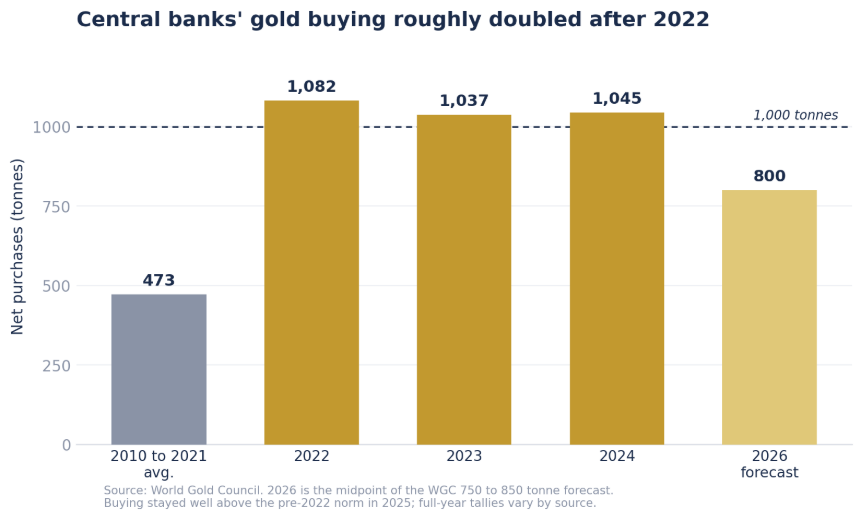
Central bank net gold purchases, tonnes. Source: World Gold Council.
China, India, and Turkey have been the largest buyers. China stopped publicly reporting its purchases in May 2024, which leads many analysts to believe its real buying is higher than the official figures. The World Gold Council expects central banks to buy another 750 to 850 tonnes in 2026, a step down from the recent peak but still far above the 400 to 500 tonnes that was normal before 2022.
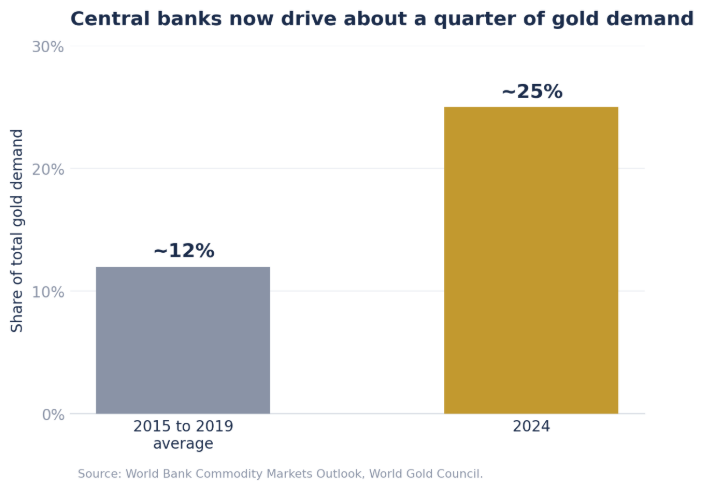
The reason this matters is that central banks do not trade gold the way investors do. They buy it as policy, slowly and without much sensitivity to price. That creates a steady floor under the market, and it has turned the official sector into one of the largest forces in gold. Central banks now account for close to a quarter of total gold demand, up from about 12% in the years before 2022.
Central bank share of total gold demand. Source: World Bank, World Gold Council.
The thinking behind it is straightforward. A US Treasury bond is a promise backed by a government that is $39 trillion in debt and may need to print money. Gold is not anyone’s liability. After the US froze Russian dollar reserves in 2022, every government that might one day fall out with Washington got a reminder that paper reserves can be switched off. Gold cannot. That is part of why BRICS nations have been steadily lifting gold’s share of their reserves.
Gold has responded. It crossed $4,000 an ounce for the first time last October and traded near $4,600 at the end of May, after climbing more than 50% in 2025. Forecasts vary widely. JP Morgan has pointed toward $5,000 by late 2026, Amundi has a $4,200 target for the year with $5,000 by 2028, and ING sees an average closer to $4,300. These are analyst views, not certainties, and gold can fall hard if geopolitical tension eases or investors are forced to sell to raise cash.
What it means
Strip away the noise and the picture is consistent. Governments around the world have borrowed more than their economies can comfortably service. Bond investors can see it, which is why yields are high and the Fed has no easy move. The dollar’s role in global trade is slowly loosening rather than breaking. And the institutions with the best long-term view of all this, the central banks themselves, are quietly moving reserves into the one asset that does not depend on anyone’s promise to pay.
None of this is a forecast that any particular thing happens next month. Markets can stay calm for a long time, and the stock market near record highs is a reminder that fear and price do not always move together. But the direction of travel is hard to miss. When the people who manage the world’s reserves keep choosing gold over paper, it is worth understanding why.
This article is published by Micro Math Capital for information and educational purposes only. It is not investment advice and is not a recommendation, offer, or solicitation to buy or sell any security. Micro Math Capital is not a registered investment advisor or dealer, and any companies mentioned are referenced for discussion only, not as an endorsement. The information comes from public filings and third-party sources believed reliable but is not guaranteed to be accurate or current, and any forward-looking views may differ materially from actual results. Investing carries risk, and small-cap and junior resource companies in particular are speculative and volatile, with possible loss of your entire investment, so do your own research and consult a licensed advisor before acting. Micro Math Capital has not been compensated for this article, none of the companies mentioned is a client, and the article is independent editorial commentary.
micromathcapital.com