A month defined by oil’s historic retreat, broad equity resilience, the Fed on hold, and small caps posting their strongest relative showing in years. Here is what moved markets in May and why it matters.
May 29, 2026 | Micro Math Capital Research
The Scorecard
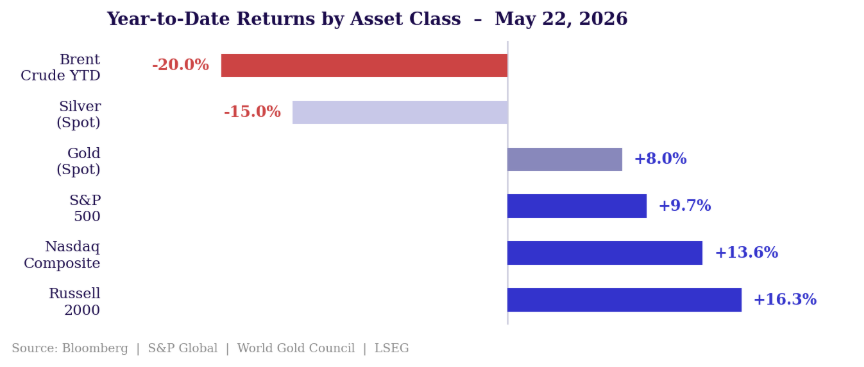
Year-to-date returns by asset class as of May 22, 2026. Russell 2000 leads all major US benchmarks. Brent crude has given back significant gains on ceasefire developments.
The S&P 500 is up 9.7 percent year to date and 29.5 percent over the trailing 12 months. The Nasdaq Composite has advanced 13.6 percent. The Russell 2000 is up 16.3 percent, leading all major US benchmarks. April was exceptional: the S&P gained 10.6 percent in a single month. Approximately 84 percent of S&P 500 companies reporting Q1 results beat profit estimates, well above the 10-year average beat rate of 74 percent. Operating margins have risen to approximately 16 percent, an all-time high.
Small Caps: The Year’s Most Important Equity Rotation
The Russell 2000’s outperformance in 2026 has a clear fundamental foundation. Smaller companies carry a disproportionate share of floating-rate debt relative to large-cap peers. The Fed’s cumulative 175 basis points of cuts since September 2024 has translated directly into reduced interest expense and improved cash flow for leveraged small-cap balance sheets. This effect is more immediate and more material for small caps than for the cash-rich mega-cap technology companies that dominated prior-year returns.
| +16.3% Russell 2000 YTD May 22 | +9.7% S&P 500 YTD May 22 | 84% S&P 500 Q1 beat rate vs 74% avg |
At the start of 2026, the Russell 2000 traded at approximately 18 times forward earnings against the S&P 500’s multiple near 26 times, a discount of more than 30 percent. Historically, small caps command a premium. The discount accumulated through the higher-rate environment of 2022 to 2024 created the conditions for a re-rating once the macro backdrop shifted. That re-rating is now in progress. The One Big Beautiful Bill Act signed in mid-2025, restoring immediate R&D expensing and 100 percent bonus depreciation, provided additional direct cash flow benefit to capital-intensive smaller companies.
After years in which mega-cap technology dominated index-level returns, capital has moved toward domestically oriented smaller companies. The rotation is supported by improving fundamentals.
Energy: Oil’s Most Volatile Month Since the Pandemic
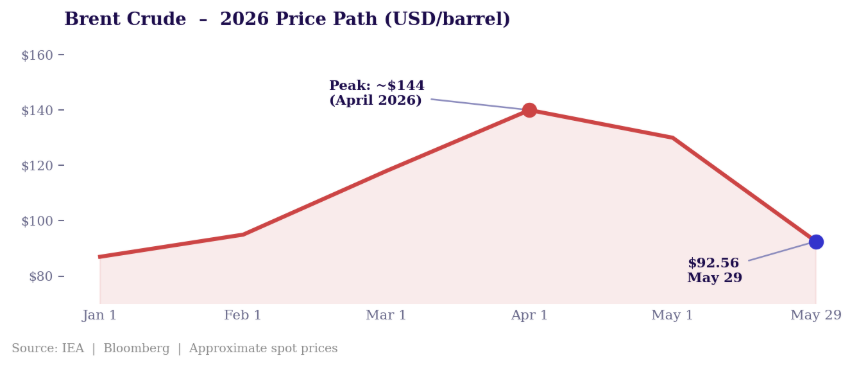
Brent crude’s 2026 price path: from under $90 in January to a peak near $144 during peak Strait of Hormuz disruption, retreating to $92.56 as ceasefire talks advanced.
Brent crude has plunged approximately 19 percent month to date, its worst monthly performance since the COVID-19 pandemic, as US-Iran ceasefire negotiations gained credibility. The context matters: the conflict began February 28, 2026 and nearly halted traffic through the Strait of Hormuz, through which more than 20 percent of global petroleum flows. Brent surged past $100 in March and reached approximately $144 at its peak. WTI similarly cleared $100. Iran crude loadings for May remain below 0.3 million barrels per day, down sharply from April’s 1.5 million and March’s 1.7 million.
Analysts at UBS note little evidence of a short-term improvement in vessel traffic or energy flows through the Strait even as prices fall on ceasefire optimism. A $90 to $100 range for Brent in the near term is the working assumption for several institutions, contingent on the pace of any diplomatic resolution.
Monetary Policy: Fed on Hold
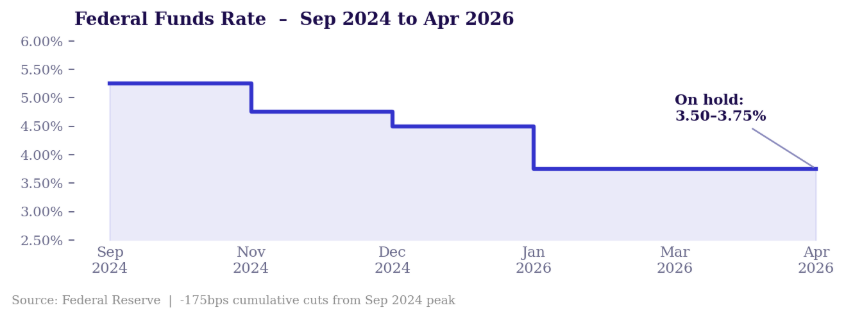
Federal funds rate path from the September 2024 cutting cycle through the April 2026 hold decision. Cumulative cuts: 175 basis points.
The Federal Reserve held the federal funds rate at 3.50 to 3.75 percent at its April 28 to 29 meeting. The FOMC minutes confirmed the Middle East conflict as a key driver of near-term asset price movements and inflation expectations. The Fed’s March projections revised both PCE and core PCE inflation higher for 2026, to 2.7 percent each. GDP growth was revised up to 2.4 percent. The committee’s view is that the oil price impact is a transitory supply-side effect they can look through, though that framing is under increasing pressure as the conflict persists.
Jerome Powell’s term as Chair expired May 15, 2026. The transition in Fed leadership introduces institutional uncertainty around the pace and communication of any future rate adjustments. Market participants are monitoring the new Chair’s policy signals closely, as a tilt in either direction would have material implications for rate-sensitive assets.
Precious Metals: Consolidation After Historic Highs
Gold is trading between $4,450 and $4,775 through May, consolidating after its January all-time high of $5,595. Silver has pulled back from its January high of $121.62, trading in the $70 to $90 range. Both metals continue to attract investor attention as portfolio diversifiers in an environment of elevated geopolitical risk, an uncertain monetary policy transition, and fiscal dynamics that raise long-term questions about dollar purchasing power. Gold mining equities continue to trade at low multiples relative to the operating margins implied by current spot prices.
What We Are Watching Going into June
The variables market participants are monitoring most closely: the status of US-Iran ceasefire negotiations and the speed at which Strait of Hormuz traffic recovers; tone and policy signals from the new Federal Reserve leadership; whether the 84 percent Q1 beat rate carries into Q2 guidance; credit spread dynamics in high yield as a leading indicator for small-cap stress; and the continued trajectory of AI capital expenditure as the primary earnings driver for large-cap technology.
The macro backdrop entering June is one of resilient earnings, a small-cap rotation supported by the data, geopolitical uncertainty that is partially resolving in energy markets, and a monetary policy environment that is on hold but not directionally clear under new leadership. That combination creates a market where sector and security selection matters more than broad index positioning. The divergence between well-capitalised profitable businesses and leveraged unprofitable ones is likely to remain a defining theme for the rest of 2026.
Published by Micro Math Capital for information only, not investment advice or a recommendation to buy or sell any security. Information is from public sources believed reliable but not guaranteed, and investing carries risk including possible total loss, so do your own research and consult a licensed advisor. This is independent editorial commentary; Micro Math Capital was not compensated and none of the companies mentioned is a client.
micromathcapital.com
Meta: What moved markets in May 2026: oil’s retreat, the small cap rotation, the Fed on hold, and gold and silver consolidating after record highs.