
The AI buildout is the largest infrastructure spend in a generation. Most of the headline capital flows to the mega-cap technology platforms. The deeper story for active investors is in the physical layer: power, cooling, networking, and the smaller companies supplying all three often at lower valuations than the mega-cap names.
May 29, 2026 | Micro Math Capital Research
Macro commentary. No positions disclosed in private credit funds discussed. https://micromathcapital.com/disclaimer/
The Scale of the Buildout
The five largest US cloud and AI providers have collectively committed between $660 billion and $690 billion in capital expenditure for 2026, nearly doubling 2025 levels. The IEA reported that capital expenditure from the largest technology companies exceeded $400 billion in 2025 and is expected to rise approximately 75 percent in 2026. Goldman Sachs estimates approximately $7.6 trillion in cumulative AI infrastructure investment between 2026 and 2031.
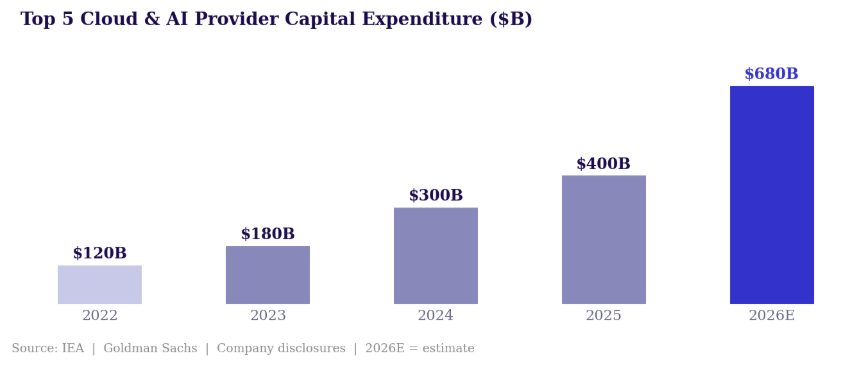
Top 5 cloud and AI provider combined capital expenditure by year. The 2026 estimate of ~$680B represents a near-doubling of 2025 levels. Source: IEA / Goldman Sachs / company disclosures.
S&P Global projects average US data center construction spending above $70 billion per quarter from 2025 through 2028. BloombergNEF reported over 23 gigawatts of data center capacity under construction globally at end-2025, roughly three-quarters in the United States. For investors, the critical question is not whether this buildout is happening. It is where value is being created along the supply chain and which parts of that chain are accessible at reasonable valuations.
The companies enabling the buildout may present more defined revenue visibility than the companies competing to win at the application layer. That is the picks and shovels argument. The data is starting to support it.
The Supply Chain Layer by Layer
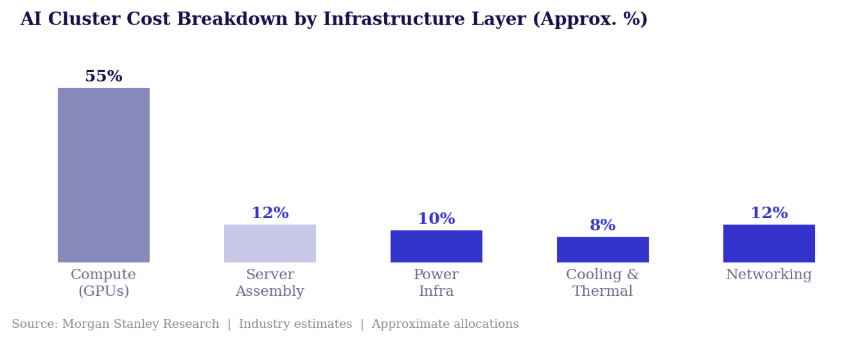
Approximate cost breakdown of a large-scale AI compute cluster by infrastructure layer. Power, cooling, and networking together account for roughly 30% of cluster cost, and growing.
The supply chain has five primary layers: compute (semiconductors and GPUs), server assembly, power generation and distribution, thermal management and cooling, and high-speed networking. Compute remains dominated by a small number of large-cap names. But power, cooling, and networking contain a broader range of companies, including mid and small-cap operators whose order books are now directly tied to data center expansion. These are the layers where active investors have identified the clearest revenue linkages without paying the premium valuations attached to the household-name semiconductor stocks.
| 23 GW Data center capacity under construction globally | $70B+ Avg quarterly US construction spend 2025-2028E | $7.6T Cumulative AI infra spend 2026-2031E (Goldman Sachs) |
Power: The Structural Constraint
Power availability has emerged as the primary constraint on data center deployment speed. Morgan Stanley Research estimates a projected shortfall of approximately 49 gigawatts in available US power access against projected demand of 74 gigawatts by 2028. US utilities are ramping annual spending to over $200 billion to expand grid capacity. Speed to power has become the primary criterion in data center site selection, displacing land cost and proximity to customers.
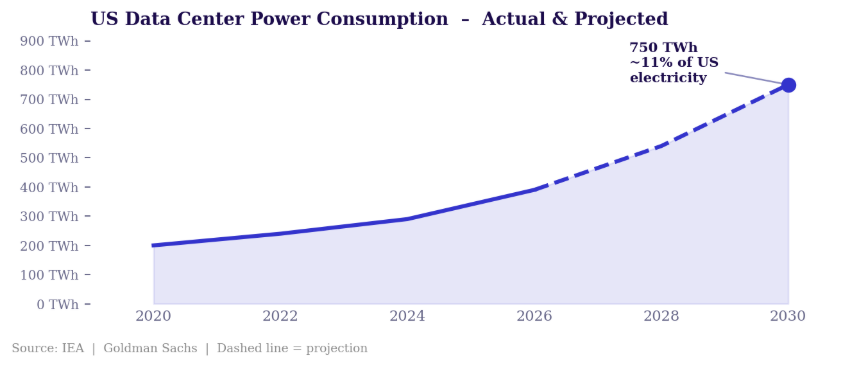
US data center power consumption actual and projected. From 200 TWh in 2020 to a projected 750 TWh by 2030, accounting for ~11% of total US electricity demand. Source: IEA / Goldman Sachs.
For small cap investors, this constraint has directed attention toward companies in electrical infrastructure: transformers, switchgear, conduit, high-voltage cable, and grid interconnection equipment. These are industrial businesses that have historically traded at modest valuations relative to technology peers but are now recording order book growth directly attributable to data center demand. Several jurisdictions, including Ireland and Texas, have implemented policies requiring data center developers to source their own power supply rather than relying on existing grid connections.
Cooling: The Thermal Management Opportunity
AI compute generates substantially more heat per rack than conventional enterprise servers. The transition to high-density GPU clusters has pushed thermal management from a background concern to a front-of-the-design engineering challenge. Liquid cooling, direct-to-chip solutions, and immersion cooling technologies have all seen accelerating demand.
Modine Manufacturing, a cooling components supplier repositioned toward the data center market, reported data center revenue growth in excess of 60 percent in fiscal 2026 after opening new manufacturing facilities specifically to meet demand. Vertiv Holdings reported a 48 percent increase in total electrical backlog as of early 2026, with institutional investors including BlackRock, State Street, and JPMorgan disclosing increased positions through late 2025. The valuation gap in smaller cooling-adjacent names has been noted by multiple analysts. As of early 2026, many small cap companies in the infrastructure space were trading at 10 to 15 times forward earnings against an S&P 500 multiple of approximately 22 times.
Many small cap infrastructure companies were trading at 10 to 15 times forward earnings even as their order books filled with AI-related demand growth.
Networking: The Less Visible Layer
High-speed networking accounts for roughly 10 to 15 percent of total AI cluster cost. As GPU clusters scale in size and density, the switching and interconnect infrastructure required to move data between compute nodes becomes a material cost challenge. Arista Networks reported Q1 2026 net sales of $2.65 billion, a 30 percent increase year-over-year, with full-year guidance implying organic growth of 29 to 31 percent. For smaller investors, the networking layer contains optical component suppliers and integrators that build the high-capacity connections between racks, pods, and regions, names that carry lower public profiles and, correspondingly, less demanding valuations.
What We Are Watching
The AI infrastructure buildout is creating a durable, multi-year revenue stream for companies well outside the traditional technology sector classification. Electrical contractors, cooling manufacturers, grid equipment suppliers, and specialty networking components producers are recording order growth traceable directly to AI giant capital expenditure programs. Many of these businesses are classified as industrials, which means they are underrepresented in AI-themed portfolios and indices.
The relevant analytical questions centre on revenue traceability, order book quality, and capacity to fulfil demand. Companies that can demonstrate a direct contractual link between their products and data center construction programs, and that have taken concrete steps to expand production capacity, are where the revenue story is clearest. The risks are also real. Project timelines shift, large-scale cloud operators’ capex guidance is subject to revision, and supply chain constraints can delay construction and equipment delivery. The structural demand for power, cooling, and networking is not speculative. Individual company execution and timing remain variable.
This article is produced by Micro Math Capital for informational purposes only. It does not constitute financial or investment advice. All figures are sourced from publicly available research, corporate disclosures, and third-party market data.
Meta: How the 2026 AI buildout is driving order growth in power, cooling, and networking, and where small cap infrastructure value is being created.