
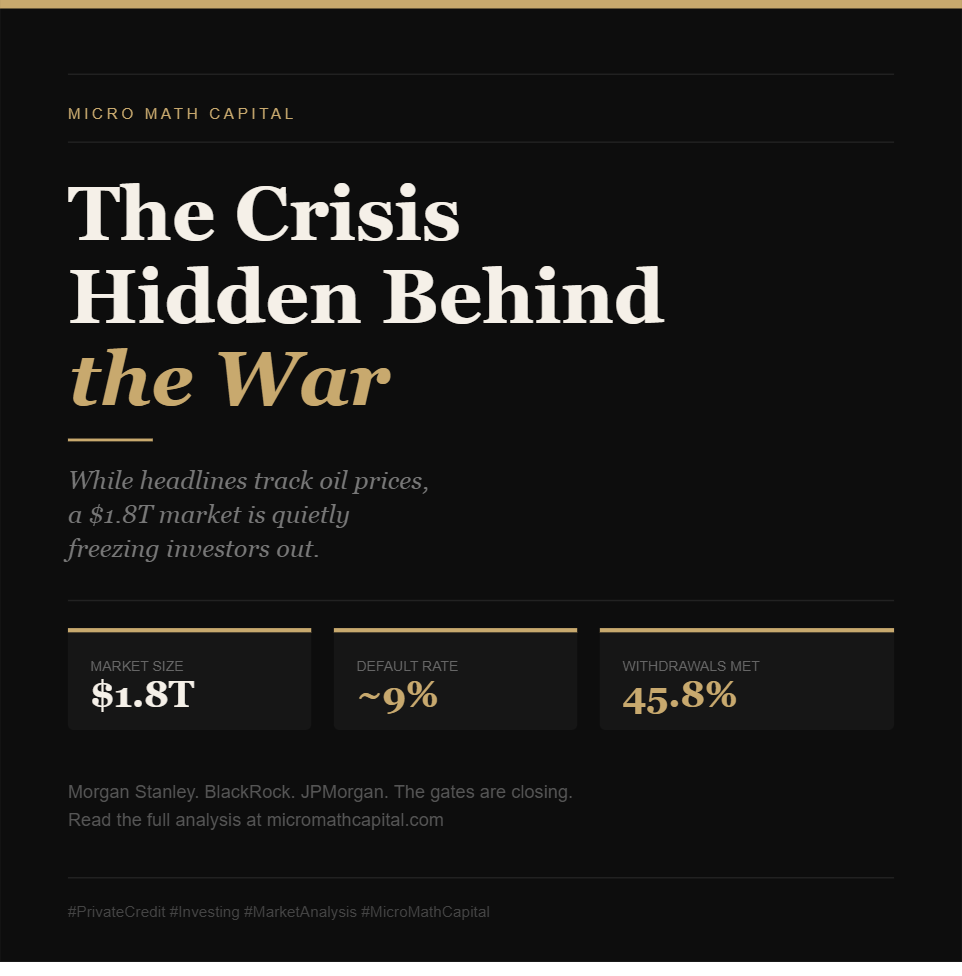
While headlines track oil prices and missile strikes, a $1.8 trillion market is quietly freezing its investors out. Here is what the numbers say, and what they mean for your portfolio.
Every crisis needs a distraction. Right now, the Iran war is providing a very good one. But while the world watches oil prices climb and the Strait of Hormuz stay shut, a different kind of freeze is happening in the financial system, one that has been building for years and is only now becoming impossible to ignore.

What Is Happening
Morgan Stanley and BlackRock, two of the biggest names in finance, have both moved to restrict withdrawals from their private credit funds in recent weeks. Morgan Stanley’s North Haven Private Income Fund received withdrawal requests totaling nearly 11% of shares and fulfilled less than half of them. BlackRock’s $26 billion HLEND fund hit similar walls after redemption requests reached 9.3% of net asset value.
The industry term for this is “gating.” The argument from fund managers is that it is a protective mechanism, not a warning sign. You cannot create liquidity from an illiquid asset class, as one deputy CIO at Corbin Capital put it. That is technically accurate. But it is also the kind of statement that deserves scrutiny.

Why This Moment Is Different
Private credit has been one of the great beneficiaries of the post-2008 financial world. As banks pulled back from riskier lending, non-bank lenders stepped in, originating floating-rate loans and issuing debt in public markets. It worked beautifully, for a while. The conditions that made it work, an inverted yield curve, ample Fed liquidity, historically low credit losses, are now gone.
Simultaneously, JPMorgan has started restricting lending to software company loans in its private credit funds and has reportedly marked down the value of certain loans after reviewing how AI-driven disruption could erode software earnings. So you have a war compressing energy-linked revenue for borrowers on one side, and technology disruption threatening the tech-heavy private credit loan book on the other.
The War as Cover
The US-Israel conflict on Iran has sent Brent crude above $106 a barrel, up over 40% in under three weeks. Gas prices in the US are up nearly 80 cents from a month ago. The Strait of Hormuz, through which roughly 20% of global oil supply moves, remains effectively closed. Those are real economic problems that deserve real attention.
But they are also very loud. And loud problems have a way of drawing attention away from quieter ones. The private credit situation was already deteriorating before a single missile was fired. Default rates approaching 9% at some funds, growing redemption pressure, JPMorgan pulling back from software loans — those signals were accumulating through late 2025. The war arrived and provided a convenient framework for volatility that obscures what was already brewing underneath.
Markets may be underpricing the confluence here. Stagflation risk, rising inflation, rising unemployment, slowing growth — is now a real scenario. And stagflation is precisely the environment that private credit loan books are least designed to handle, since most of these loans are floating-rate and tied to companies that need stable growth conditions to service their debt.
What We Are Watching
For now, there is no systemic collapse. Fund managers are not wrong that redemption gates are a feature written into these products. But gates are a feature until they become a signal, and right now they are functioning as both simultaneously. The question is which interpretation the next wave of data supports.
We will be watching default rates closely. A drift from 9% toward 12 to 15% would meaningfully change the calculus for anyone holding private credit vehicles. We will also watch whether JPMorgan’s loan markdowns become an industry-wide adjustment or remain contained. And we will watch whether the Fed’s expected rate cuts materialise on a timeline that actually relieves pressure on variable-rate borrowers, or whether persistent inflation from the oil shock delays that relief.
High-quality growth companies with strong balance sheets, real cash flow, and limited debt will outperform in this environment. While not groundbreaking, this point warrants emphasis now, as the allure of energy and defense stocks is strong. The numbers matter. The math matters. And right now, the math surrounding private credit requires greater scrutiny.